A study conducted in 2011 determined that 40-60% of girls in elementary school are concerned about their weight and/or “getting too fat” (Smolak, 2011).
Of American elementary school girls who read magazines, 69% say that the pictures influence their concept of the ideal body shape. 47% say the pictures make them want to lose weight (Martin, 2010).
The rate of development of new cases of eating disorders has been increasing since 1950 (Hudson et al., 2007; Streigel-Moore &Franko, 2003; Wade et al., 2011).
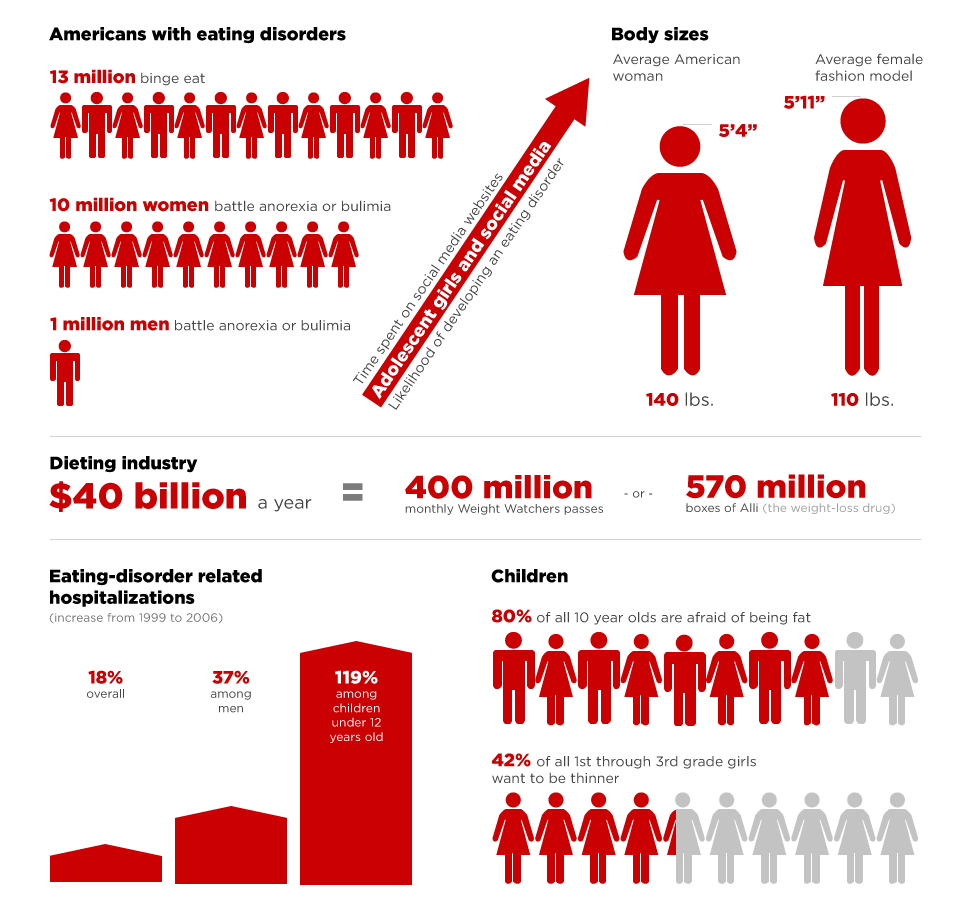
From CNN.com
As an aunt to six amazing little girls, these statistics, though not surprising, are incredibly scary.
If you were to ask me about eating disorders 5-10 years ago, I would have shrugged my shoulders and assumed it was something that only affected women who were “crazy” or had a history of abuse. While eating disorders certainly don’t discriminate, they are more prominent in Caucasian women who fit this psychological profile:
“perfectionism, high self-expectations, competitiveness, hyperactivity, repetitive exercise routines, compulsiveness, drive, tendency toward depression, body image distortion, pre-occupation with dieting and weight” (Bachner-Melman et al., 2006)
As a Caucasion woman (almost) in my thirties with a desire to be successful, I happen to identify with most of these traits. In fact, I also see these traits in many of my friends. That’s why I think it’s so important to 1. Bring awareness to something that is often kept hidden and 2. Join the grassroots movement to change the role the media has in society’s standards of “beauty”.
While I didn’t develop disordered eating habits and an obsession with exercise until my twenties, it can happen to ANYONE at ANY TIME under the “right” circumstances. I call the circumstances that led me down this dark path as my “Perfect Storm“. These include (but are not limited to):
1. An exposure to dieting at a young age
2. Weight gain in high school and college from overindulging (food, alcohol) and not exercising
3. An inherent drive to have more and be better
4. Nutrition misconceptions
5. Growing obsession with exercise

I’m convinced that nearly every woman I know has an unhealthy relationship with food. The degree and capacity may vary, but the control it can have is real. No one is immune and a combination of life triggers can cause it to grow. However, I believe education and awareness is key to prevention. I applaud the growing number of celebrities coming forward with their stories, most recently from Extreme Weight Loss TV star Heidi Powell. It can be a powerful thing when celebrities use their fame for good and give a face to such a hidden cause.
Regardless of where you may fall on the “ED” continuum, please know that you are not just a number on a scale, calories burned, or grams of carbohydrates consumed. You are not the food you eat, percent of fat or waist in inches. You’re so much MORE. Let’s instead use the power we’ve been giving food to do things that really matter: Making sure we’re not breeding another generation of women overly occupied with weight.
XoXo
Katie
Bachner-Melman, R., Zohar, A, Ebstein, R, et.al. 2006. How Anorexic-like are the Symptom and Personality Profiles of Aesthetic Athletes? Medicine & Science in Sports & Exercise 38 No 4. 628-636.
Hudson J. I., Hiripi E., Pope H. G. Jr., & Kessler R. C. (2007). The prevalence and correlates of eating disorders in the National Comorbidity Survey Replication.Biological Psychiatry, 61, 348-358.
Martin, J. B. (2010). The Development of Ideal Body Image Perceptions in the United States.Nutrition Today,
45(3), 98-100. Retrieved from nursingcenter.com/pdf.asp?AID=1023485
Smolak, L. (2011). Body image development in childhood. In T. Cash & L. Smolak (Eds.),
Body Image: A Handbook of Science, Practice, and Prevention (2nd ed.).New York: Guilford.
Streigel-Moore R. H.,&Franko D. L. (2003). Epidemiology of binge eating disorder.International Journal of Eating Disorders, 34, S19-S29.
Wade, T. D., Keski-Rahkonen A., & Hudson J. (2011).Epidemiology of eating disorders. In M. Tsuang and M. Tohen (Eds.), Textbook inPsychiatric Epidemiology (3rd ed.) (pp. 343-360). New York: Wiley.
 thirtystars